
Walnuts can be a nutritious snack and a hearty, delicious addition to a wide variety of recipes, from baked goods to savory dishes. Walnuts are an excellent source of polyunsaturated fat—a healthy fat that can boost heart health and provide other benefits. There are different varieties of walnuts, but English walnuts are the most common.
Walnut Nutrition Facts
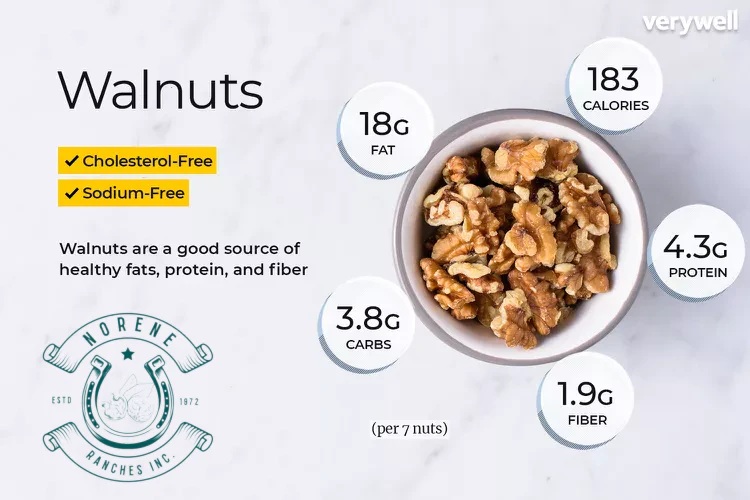
The following nutrition information is provided by the USDA for one ounce (28g) or about seven whole English walnuts or 14 halves.1
Calories: 183
Fat: 18g
Sodium: 0.6mg
Carbohydrates: 3.8g
Fiber: 1.9g
Sugars: 0.7g
Protein: 4.3g
Would you believe that walnuts (scientific name Juglans regia L.) have been providing crucial nutrients to humans for nearly 8,000 years?
A report on walnuts published in the American Journal of Nutrition states:
Compared to most other nuts, which contain monounsaturated fatty acids, walnuts are unique because they are rich in n-6 (linoleate) and n-3 (linolenate) polyunsaturated fatty acids. Walnuts contain multiple health-beneficial components, such as having a low lysine: arginine amino acid ratio and high levels of arginine, folate, fiber, tannins, and polyphenols.
As you’ve probably noticed, one of the areas where walnuts nutrition shines most is the nut’s high supply of omega-3s benefits, including:
Omega-3 fatty acids are not only helpful for heart health and brain health, but also for controlling inflammation and improving circulation, memory, thought processing and blood sugar control.
The human species evolved on a diet that contained high amounts of omega-3 fatty acids — the kind found in wild fish like salmon, flaxseeds, walnuts and wild game — and much less of the polyunsaturated fats called omega-6 fatty acids, found in vegetable oils, packaged foods, and some nuts and seeds.
In the past several centuries, we have gradually consumed more omega-6s, especially from vegetable oils, and on average much fewer omega-3 foods. Instead of the roughly ideal two-to-one, or even one-to-one, ratio of fats consumed by our ancient ancestors, today it’s believed that the average American eats 15 to 25 times more omega-6 fats than omega-3s.
Eating more walnuts as part of a healing diet can help close this gap and potentially prevent disease development. For example, walnuts nutrition benefits were praised in the Journal of Alzheimer’s Disease as providing a “significant improvement in memory, learning ability, anxiety, and motor development compared to the control diets without walnuts.”
In addition to omega-3s, walnuts nutrition provides plenty of other noteworthy nutrients too. According to walnut nutrition data published by the USDA, one ounce (approximately 28 grams) of walnuts nutrition, or about 14 halves, has about:
185 calories
3.9 grams carbohydrates
4.3 grams protein
18.4 grams fat
3.9 grams fiber
1 milligram manganese (48 percent DV)
0.4 milligram copper (22 percent DV)
44.6 milligrams magnesium (11 percent DV)
97.8 milligrams phosphorus (10 percent DV)
0.2 milligram vitamin B6 (8 percent DV)
27.7 micrograms folate (7 percent DV)
0.1 milligram thiamine (6 percent DV)
0.9 milligram zinc (6 percent DV)
0.8 milligram iron (5 percent DV)
In addition, walnuts nutrition contains some vitamin A, vitamin C, vitamin E, vitamin K, niacin, pantothenic acid, choline, betaine, calcium, potassium and selenium.
Carbs
A single serving of walnuts only contains about 3.8 grams of carbohydrates. A very small amount of that is starch (0.017g) and a small amount is naturally occurring sugar (0.7g). Most of the carbohydrate in walnuts comes from healthy fiber (1.9g).
The estimated glycemic index of walnuts is 15, making them a low-glycemic food The glycemic load of a single serving of walnuts is estimated to be 1. Glycemic load takes portion size into account when predicting a food’s impact on blood sugar. A glycemic load of 1 has very minimal impact on blood sugar.
Fats
Most of the calories in walnuts come from fat. You’ll consume 18 grams of fat when you eat a single serving of the nuts. Most of the fat is polyunsaturated fat (13.4g) but some is monounsaturated fat (2.5g) and a very small amount is saturated fat (1.7g).
Polyunsaturated fats and monounsaturated fats are considered healthy fats. They generally come from plant sources like nuts, seeds, and avocado. Research has consistently shown that replacing saturated fats with polyunsaturated or monounsaturated fats helps to decrease your risk of heart disease.2
Protien
In addition to providing fiber and healthy fat, walnuts also provide a healthy boost of protein. A single serving provides over 4 grams.
Protien
At about 183 grams per serving, most of the calories in walnuts are from healthy fats.
Vitamins and Minerals
Walnuts are an excellent source of manganese and copper, providing half your daily needs. They are also a good source of magnesium and phosphorus. The nuts also supply smaller amounts of iron, calcium, zinc, potassium, and selenium.
Vitamins in walnuts include vitamin B6, folate, and thiamin.